
SEO Writing Structure! Google Prefers This Format


SEO Writing Structure! Google Prefers This Format
In the previous lesson, we learned how to create compelling titles that attract clicks.
Now that you've drawn visitors with a great title, it's time to build an easy-to-understand article structure for Google.
Many beginners think writing longer content automatically improves SEO.
But Google analyzes not just the length but also the structure of your content.
Articles that are easy for people to read are also easier for search engines to understand.
In this lesson, we'll explore a simple SEO writing structure that beginners can apply immediately.
Why Article Structure Matters for SEO
Think of a book as an example.
A book has:
Title
Table of contents
Chapters
Subheadings
The same structure applies to web pages.
As Google reads your content's structure, it understands:
"What is this article about?"
The better organized the content, the easier it is for search engines to analyze its meaning.
What Is an H1?
An H1 is the largest heading in your article.
Typically, this is your main post title.
Examples:
How to Get AdSense Approval
What is SEO?
WordPress Installation Guide
Each article should have only one H1 heading.
H2s Divide Major Topics
H2 headings divide major sections of your content.
For example, under "How to Get AdSense Approval," you might include:
Approval Requirements
Preparation Steps
Application Process
After Approval Actions
These section headings are H2s.
H3s Explain Details Within Sections
H3 headings provide more detail within an H2 section.
For example:
H2: Preparation Steps
H3: Number of Articles Needed
H3: Privacy Policy Page
H3: Contact Page Requirements
This step-by-step structure makes content easier to understand.
Keep Paragraphs Short
Long paragraphs are difficult to read, especially on mobile devices.
The recommended approach is to break text into 2-4 line segments per paragraph.
Shorter paragraphs improve readability and encourage visitors to stay longer on your page.
Use a Table of Contents
A table of contents benefits both readers and search engines.
For example:
What is SEO?
What is an H1?
What are H2s?
What are H3s?
FAQ
Showing a table of contents at the beginning helps visitors find what they need quickly.
Images Help with SEO Too
Images aren't just for visual appeal—they help explain concepts more clearly.
For example:
Tables
Graphs
Screenshots
Comparison images
Using these types of visuals improves content quality.
Avoid overusing images—use them where they're most helpful.
Add an FAQ Section for Better Engagement
FAQs address common questions readers might have:
Q. How long should my article be?
Q. Are images necessary?
Q. Can I use AI to write content?
Adding these at the end helps resolve visitor queries.
Search results may also display FAQ-style snippets for these questions.
Maintain a Logical Flow
A good article follows a natural sequence:
Problem Statement → Explanation of Causes → Solution Methods → Important Notes → Conclusion
This structure makes reading easier. Jumping between unrelated topics can cause visitors to leave quickly.
Use Tables and Lists Effectively
When your content is detailed, use tables and lists instead of long sentences.
For example:
Characteristics of Good Titles:
Includes target keywords
Clear and specific content
Avoids being too short or long
This format makes complex information easier to digest.
Add Internal Links for Better Navigation
If you have related articles, link to them within your content.
For example:
This article covers:
What is SEO?
How to Find Keywords
Title Writing Techniques
Linking to previous lessons encourages visitors to read more content on your site.
This increases time spent on your site, which benefits SEO.
Common Mistakes Beginners Make
The following practices can hurt your SEO efforts:
No subheadings after the main title
Overly long paragraphs
No images included
Inconsistent article flow
No FAQ section
No internal linking
Fixing these issues can significantly improve your content quality.
SEO Writing Checklist
Before publishing, check:
Is there only one H1?
Are content sections divided using H2 and H3 headings?
Are paragraphs kept short (2-4 lines)?
Are images used appropriately?
Is there a table of contents?
Has an FAQ section been added?
Are relevant internal links included?
Is the content mobile-friendly?
Using this checklist regularly will quickly improve your SEO writing skills.
Good Structure Creates Better SEO
SEO isn't just about search engines—it's about creating content that's easy for people to read.
Well-structured articles lead to:
Visitors reading longer,
Search engines understanding content better,
And higher visibility in search results.
A good structure is the foundation of quality content.
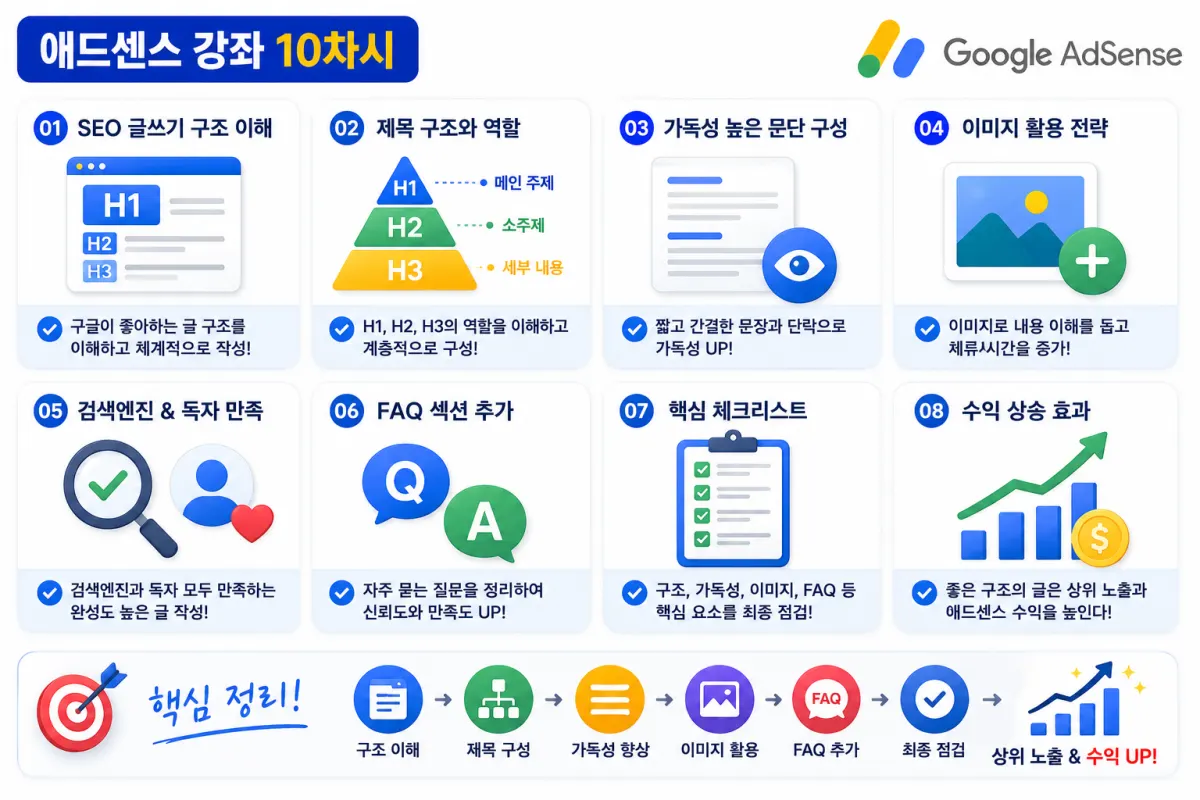
Conclusion
Quality content starts with a strong structure.
Using H1, H2, and H3 headings appropriately, keeping paragraphs short, and incorporating images and FAQs will create content that satisfies both readers and search engines.
In our next lesson, we'll cover how to choose profitable keywords for AdSense revenue.
Even with the same traffic volume, differences in CPC (Cost Per Click), RPM (Revenue Per Mille), and competition levels can significantly impact your earnings. We'll share practical strategies for selecting high-value keywords.
FAQ
Why does article structure matter for SEO?
Search engines analyze the organization of your content to understand its main topic and purpose. Well-structured articles are easier for both readers and search engines to process.
How long should paragraphs be in SEO-friendly content?
Keep paragraphs short—ideally 2-4 lines—to improve readability, especially on mobile devices. Long paragraphs can deter visitors from staying on your page.
Korean Source
This article is an English localization of a Korean-language report from BlogScore. Original: [10차시-실전편] SEO 글쓰기 구조! 구글이 좋아하는 글은 따로 있다