
SEO Success: The Power of Consistent Content Updates and Edits

SEO Isn't Finished When You Publish
Many new bloggers think:
"I've published the article, so it's done."
But in SEO,
management can be more important than publication.
Search engines continuously reflect
new information
user feedback
current trends
over time. Therefore, a site that consistently manages its content is more likely to receive better rankings than one that leaves old articles untouched.
Google Prefers Up-to-Date Information
For example,
consider an article written in 2024 about "AdSense approval time."
If the approval policy has changed, the old information may no longer be helpful.
In that case, adding updated content makes search engines more likely to view the page as actively managed.
Users also benefit from getting current information, which increases satisfaction.
When Should You Update Your Content?
Consider updating your article in these situations:
Information is outdated
Search rankings have dropped
New features or updates are available
Competitor content has improved
Users frequently ask similar questions
SEO success hinges on consistent management.
What Parts Should You Update?
When updating an article, don't just change the date—improve the actual content. For example:
Add current information
Delete outdated content
Add new examples
Replace old images
Add tables or charts
Incorporate FAQs
Correct typos
Search engines positively evaluate pages where the content has genuinely improved.
Review Your Titles Too
For articles with low rankings, simply updating the title can improve click-through rates.
For example,
Old title:
Learning SEO
New title:
The Complete Guide to Search Engine Optimization for Beginners
Reflecting core keywords, search intent, and compelling language naturally can yield great results.
Maintain Updated Meta Descriptions
Meta descriptions should also be reviewed regularly.
If your article's content changes, update the meta description accordingly.
In search results,
the meta description should accurately represent what the page offers.
Update Internal Links Too
If you've written new articles, link to them from existing posts as well.
For example,
If this SEO series continues,
add links to previous,
next,
and related lessons
within your older articles. This helps search engines better understand content relationships.
Replace Outdated Images
If images are old or the screenshots have changed, replace them with updated visuals.
For example,
If Google Search Console's interface has been updated, use a current screenshot—it will be more helpful for users.
Remember to update ALT attributes when changing images too.
Leverage Search Console Data
You can find metrics like
impressions
clicks
average position
search terms
in Google Search Console.
For instance,
If you have high impressions but low click-through rates, try revising your title or meta description.
If average positions are slightly lower, consider improving the main content.
Using data to guide updates is the most effective approach.
Add User Questions
If you notice repeated questions in comments or messages,
adding those answers directly into your article can be beneficial.
For example,
Incorporating an FAQ section helps users get all their questions answered in one place.
Search engines may also see the content as more comprehensive and valuable.
Updates Are Even More Critical in the AI Era
You can quickly create articles with AI tools,
but if you don't manage them after publishing,
content relevance may decline over time.
If you draft an article using AI, regularly add:
current information
real-world examples
personal experience
new images
To keep your content competitive.
Update History Is a Positive Signal
When editing an article, consider adding the last update date for transparency.
For example,
Last updated: July 2026
This gives users confidence that they're reading current information,
especially valuable for informational content.
Common Mistakes New Bloggers Make
The following mistakes can hurt your SEO performance:
Never updating after publishing
Only changing the date
Using old images without replacement
Failing to check Search Console data
Not updating internal links
Ignoring user questions in content
A simple habit of regular management can significantly improve search performance.
Update Checklist
Before editing an existing article, check these items:
Is the latest information included?
Does the title match search intent?
Does the meta description reflect current content?
Are internal links up to date?
Are images and ALT attributes appropriate?
Should new FAQs be added?
Have Search Console metrics been reviewed?
This checklist helps manage content more systematically.
SEO Success Comes from Consistent Management
Many top-ranking articles weren't perfect from the start.
They improved over time through consistent updates and revisions.
While creating new content is important,
focusing on enhancing existing high-quality content can have a much greater long-term impact for SEO strategy.
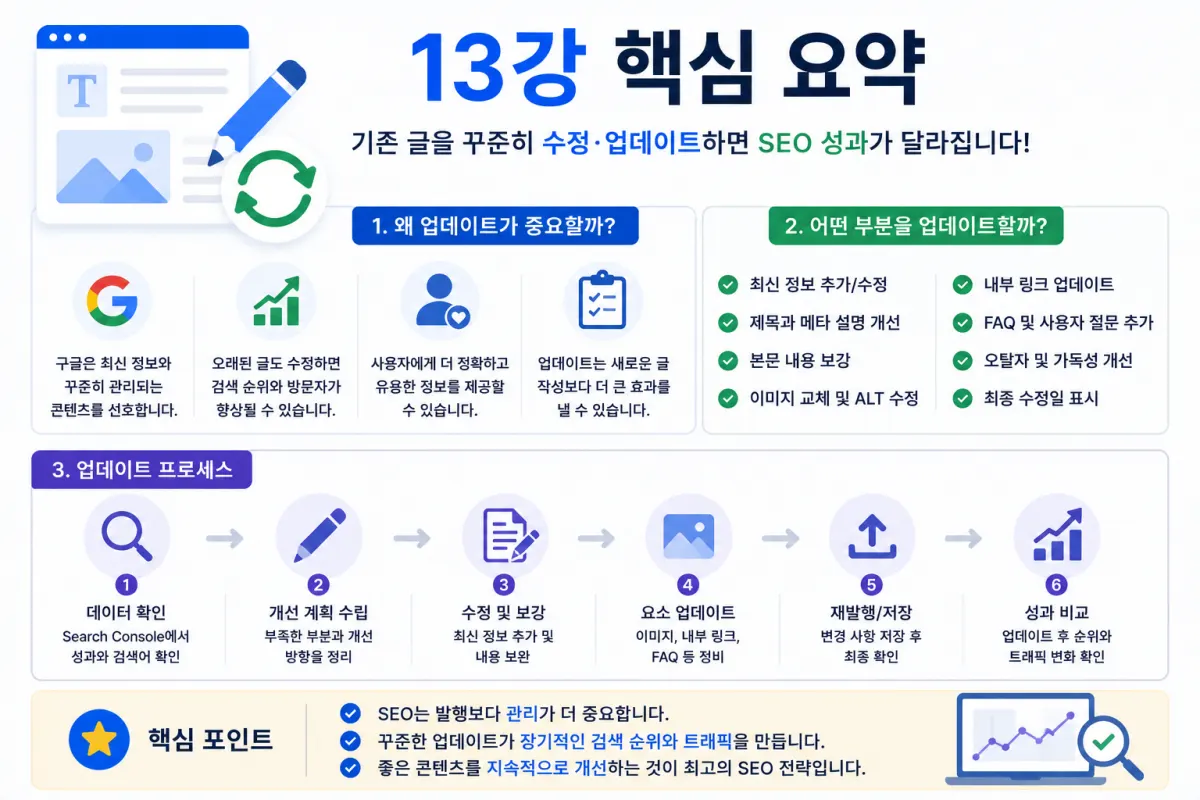
Key Takeaways from This Lesson
In this lesson, we covered strategies to improve your SEO through strategic editing and updating of existing articles.
The key points are:
SEO success often depends more on management than publication.
Consistently incorporate current information into your content.
Review titles and meta descriptions for alignment with search intent.
Update internal links and images to maintain relevance.
Leverage Search Console data to guide effective improvements.
Incorporate FAQs and user questions to increase content value.
Consistent updates drive long-term SEO success.
Search engines favor content that is consistently managed and continues to provide value to users over time.
In the next lesson, we'll explore "Can AI-Generated Content Be Optimized for SEO? Practical Strategies for Real-World Implementation" to learn how to effectively manage SEO in the age of artificial intelligence.
FAQ
Why is updating old blog posts important for SEO?
Search engines favor content that is regularly updated with current information, which improves rankings and user satisfaction.
What should I update when revising a blog post?
Update the title, meta description, internal links, images, and add new examples or FAQs to improve relevance and engagement.
Korean Source
This article is an English localization of a Korean-language report from BlogScore. Original: [SEO 13강] SEO 성과를 높이는 글 수정과 업데이트 전략