
[SEO Lesson 3] Why Keyword Selection Accounts for 80% of SEO Success


Why Are Keywords So Important?
Many people starting with SEO make the same early mistake: they write content first.
But SEO begins not with writing, but with selecting the right keywords.
For example, imagine you've written an excellent article about cars. However, if people are searching for:
Electric car subsidies
Used car recommendations
Car insurance cost calculator
but your title is "A Story About Cars", it's unlikely to appear in search results.
This is because searches begin with the keywords users type into the search bar.
Keywords Are Users' Questions
The phrases people type into search bars are all questions.
For example:
How to reduce air conditioner electricity bills
How to make iPhone battery last longer
AdSense approval time
Learning SEO
All of these are keywords.
In short, thinking of keywords as questions users want answered makes the concept much easier to understand.
SEO is about providing the best answer to those questions.
Choosing Keywords Based Only on Search Volume Leads to Failure
Newcomers often choose keywords with high search volume first.
But a high search volume also means intense competition.
For example, the keyword "diet" has massive search volume. However, it's already dominated by large websites, hospitals, and media outlets, making it difficult for a new blog to rank highly.
On the other hand, more specific keywords like "Diet plan for office workers in their 40s" face much less competition.
This type of keyword is called a long-tail keyword.
Why Long-Tail Keywords Matter
Long-tail keywords may have lower search volume, but they offer significant advantages.
For example:
"Laptop"
is less specific than
"Best laptops for college students doing video editing"
The latter clearly indicates what users are looking for, leading to higher satisfaction after clicking through.
They also face less competition, making it easier to rank well in search results.
For new blogs starting SEO, focusing on long-tail keywords is much more effective.
Characteristics of a Good Keyword
A good keyword isn't just about high search volume. It should meet these criteria:
Keywords People Actually Search For
The keyword must be something people actually search for.
If no one searches it, you won't get visitors.
Clear Search Intent
It should be easy to understand what users are looking for.
For example:
"AdSense"
is less clear than
"How long does AdSense approval take?"
Moderate Competition
New blogs struggle to compete with large websites.
It's better to start with more specific keywords.
Can Be Fully Covered in One Article
Keywords that solve a single question are better for SEO than broad topics.
One Keyword Per Article Is the Rule
Many beginners try to include multiple keywords in one article.
But search engines find it hard to understand what the article is about if it covers too many topics.
For example, writing an article covering:
AdSense
SEO
WordPress
Blogging
YouTube
is less effective than focusing on just one keyword like "How long does AdSense approval take?".
The most effective approach is to focus each article on a single core keyword.
Start With Keywords in Your Title
Search engines read titles first.
So it's best to include your main keyword near the beginning of the title.
For example, instead of:
❌ "A Story About SEO That You Need to Know When Running a Blog"
use:
✅ "What is SEO? A Simple Guide for Beginners on How Search Engines Work"
This helps both search engines and users quickly understand the content.
Naturally Use Keywords
In the past, repeating keywords was thought to help SEO.
But now, it's the opposite. Articles that sound unnatural due to keyword stuffing don't get good rankings:
SEO is important for SEO. To learn SEO, you need to study SEO.
Instead of forcing repetition, use your main keyword naturally in the title, first paragraph, subheadings, and body where appropriate.
How to Find Good Keywords
You can find good keywords from various sources:
Google Autocomplete
Naver Autocomplete
Related search terms
People Also Ask questions
Search trends
Comments and community discussions
News and trending topics
Selecting keywords based on what users actually want to know naturally leads to creating high-quality content.
Common Mistakes Beginners Make
New SEO starters often make these mistakes:
Choosing keywords only by search volume
Selecting overly broad keywords
Including multiple keywords in one article
Mismatched title and keyword focus
Failing to answer users' actual questions
Simply avoiding these mistakes can significantly improve your search traffic.
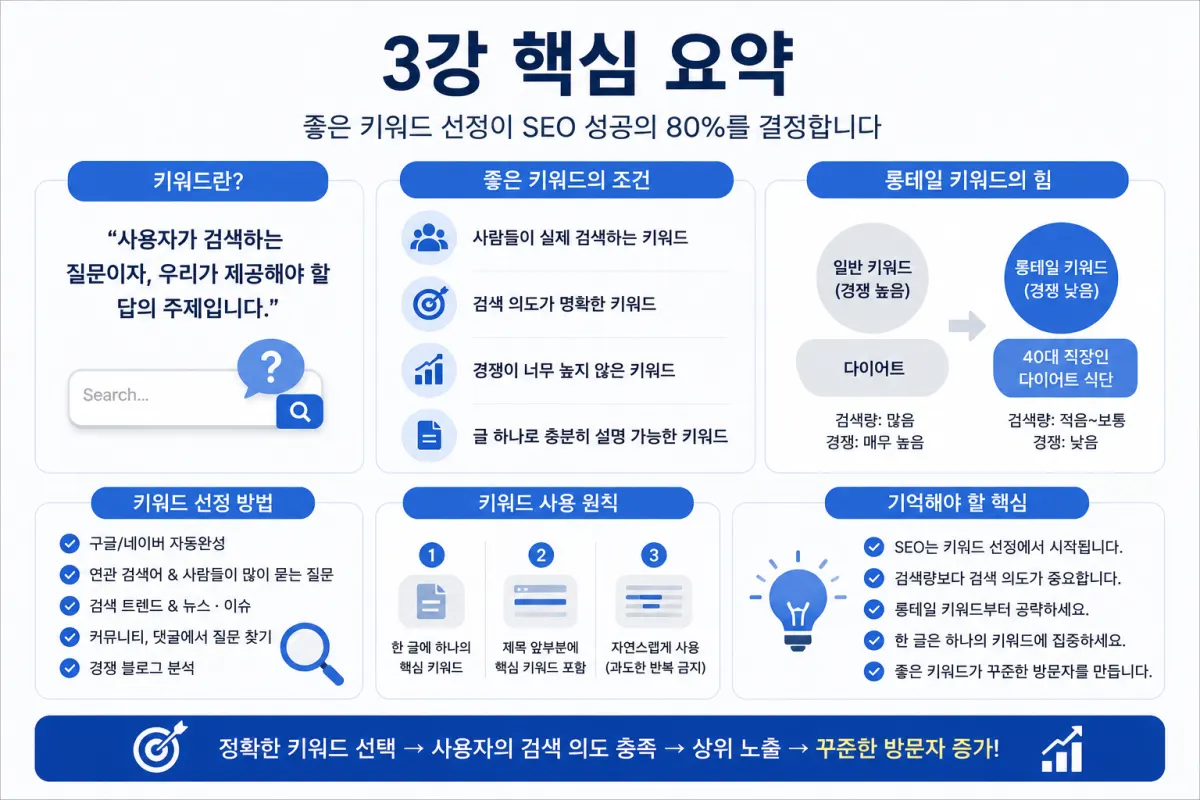
Key Takeaways from This Lesson
This lesson covered the most important aspect of SEO: how to select effective keywords.
The key points to remember are:
SEO starts with keyword selection.
Keywords represent users' questions.
Search intent matters more than search volume.
Long-tail keywords benefit beginners.
One article should focus on one main keyword.
Incorporate your main keyword naturally in the title.
Avoid keyword stuffing; use keywords naturally instead.
Selecting good keywords means you've already succeeded in more than half of SEO.
Next lesson: "Understanding Search Intent (More Important Than Search Volume)", where we'll explore how to create content that meets users' actual needs.
FAQ
What is a long-tail keyword?
A long-tail keyword is a more specific, longer search phrase with lower competition but higher intent, like 'best laptop for college students' instead of just 'laptop'.
Why should beginners focus on long-tail keywords?
Long-tail keywords have less competition and clearer user intent, making it easier for new blogs to rank well in search results.
Korean Source
This article is an English localization of a Korean-language report from BlogScore. Original: [SEO 3강] 키워드 선정이 SEO의 80%인 이유