
SEO Fundamentals: How Search Engines Find and Rank Your Content


What Is SEO?
If you're starting a blog, you might think:
'If I write great content, people will find it on their own.'
But reality is different.
Even excellent content won't appear in search results if search engines can't discover or understand it properly.
SEO—short for Search Engine Optimization—solves this problem.
In simple terms, SEO helps search engines better understand your content.
How Do Search Engines Find Content?
Search engines don't browse the web like humans. Instead, they use automated programs called crawlers or bots.
Crawlers scan websites to discover new content.
Here's how search engines process content:
Discover a new page.
Read the page's content.
Analyze titles and body text.
Determine the topic.
Store it in their database.
Show the most relevant result when users search.
This process is why you write content—to get through it successfully.
Search Engines Think Like Humans Now
In the past, stuffing keywords could boost rankings. Today's engines are smarter.
They evaluate:
If the content answers real questions
If it's easy to read
If information is accurate and up-to-date
If it’s original (not copied)
If users are likely to read it fully
Simply put, search engines favor content that genuinely helps people.
SEO Is About Writing for People, Not Just Search Engines
Many beginners focus only on search engines when learning SEO.
But the most important audience is human readers.
Search engines evolve to find content that satisfies users. For example:
If someone searches 'how to reduce air conditioner electricity bills,' they want practical tips—not a historical essay.
Aligning with search intent is the first step in effective SEO.
Search Engines Analyze Content Structure Too
Search engines don't just read titles—they assess overall structure.
Clear structures help them understand content better, such as:
Title (H1)
Main headings (H2)
Subheadings (H3)
Paragraphs
Images
Tables
Lists
The more organized your content, the easier it is for search engines to interpret.
Not All Content Appears in Search Results
Search results face intense competition. For example:
A simple search like 'laptop recommendations' returns millions of pages.
Search engines prioritize the most helpful content first.
Thus, SEO isn't about beating competitors—it's about delivering better value to users.
Benefits of Good SEO
The biggest advantage? Getting free traffic without ads.
A well-optimized post can attract visitors for years through search.
Key benefits include:
Consistent growth in organic visits
Lowers ad spending needs
Boosts blog credibility
Potential AdSense revenue
Becomes a long-term online asset
This is why businesses and individuals prioritize SEO.
SEO Isn't Learned Overnight
There's no single 'right' way to do SEO. Search engines evolve, and user behavior changes.
But one principle remains constant: Create helpful content for people.
Master this, and you'll create content that stays relevant despite algorithm updates.
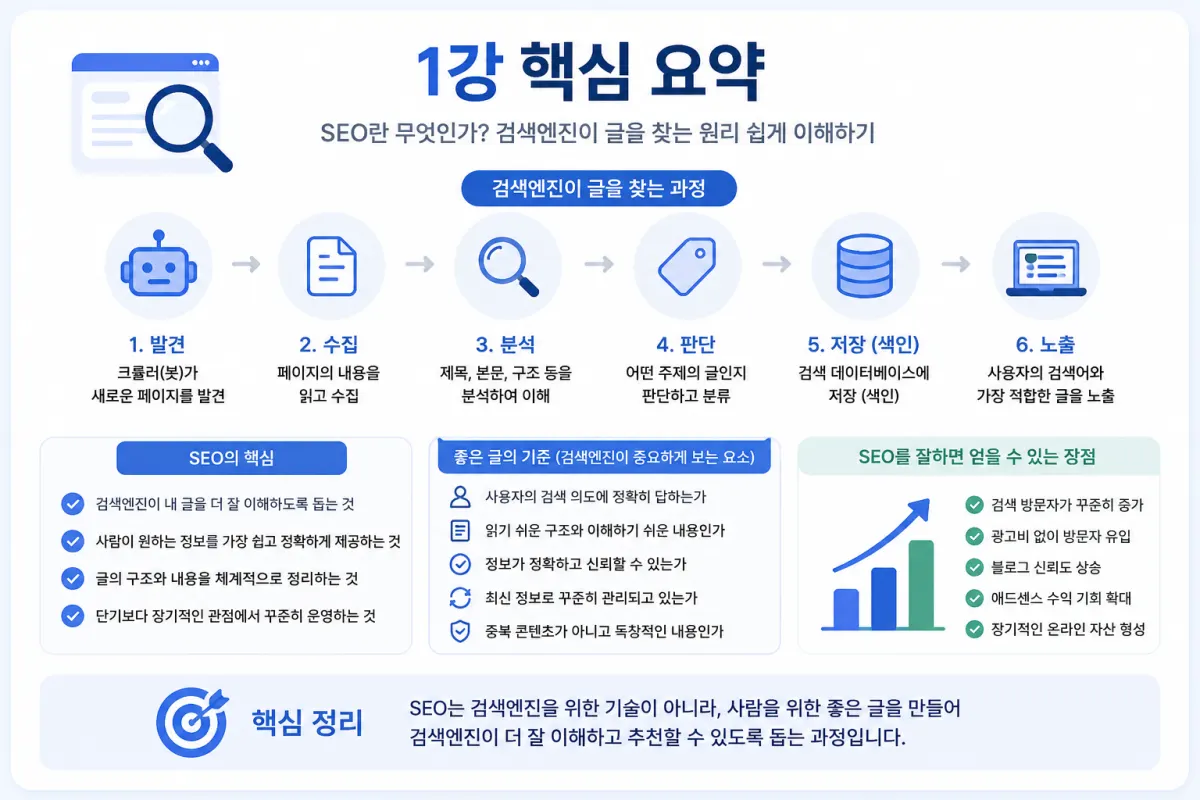
Key Takeaways From This Lesson
This lesson covered SEO basics. Remember:
SEO = Search Engine Optimization
Search engines use crawlers to find content
Good SEO prioritizes people over search engines
Well-structured content is easier for engines to understand
SEO is a long-term strategy, not a quick fix
Understanding these fundamentals makes advanced topics like keyword research, title writing, and image optimization much clearer.
In the next lesson, we'll explore 'Why Google Ranks Certain Content: Core SEO Principles', diving deeper into how search rankings are determined.
FAQ
What does SEO stand for?
SEO stands for Search Engine Optimization, the practice of improving content to help search engines understand and rank it better.
Do I need to stuff keywords to rank higher?
No. Modern search engines prioritize helpful, well-structured content over keyword stuffing.
Korean Source
This article is an English localization of a Korean-language report from BlogScore. Original: [SEO 1강] SEO란 무엇인가? 검색엔진이 글을 찾는 원리 쉽게 이해하기