
SEO 201: Why Does Google Rank Some Articles Higher Than Others?


Why Does Google Rank Some Articles at the Top While Others Stay Hidden?
Even when writing about the same topic, some articles appear on the first page of search results while others get buried on page 50 or beyond.
Many assume there's a secret algorithm, but the truth is simpler than you think.
Google's sole goal is straightforward:
To provide users with the fastest and most accurate answer to their query.
In other words, search rankings are ultimately based on user satisfaction.
Search Intent Matters More Than Keywords
In the past, stuffing keywords into articles could boost rankings.
Today, Google doesn't just count keyword frequency.
For example, if someone searches for:
"save on air conditioner electricity costs"
they're likely looking for practical information like:
Why their AC uses so much power
Actual ways to reduce costs
Optimal temperature settings
Electricity cost calculations
If most articles only talk about ads, Google won't consider them high-quality content.
The key metric is how well the content addresses the user's search intent.
Google's Top Ranking Factors
Rankings aren't determined by a single factor.
Google evaluates multiple elements together.
Key factors include:
Helpful Content
Does it answer the user's question?
Is it genuinely useful when read?
Accuracy
Are there any factual errors?
Is the information trustworthy?
Readability
Are paragraphs appropriately spaced?
Are headings (H2, H3) well-organized?
Does it work well on mobile devices?
Recency
Is the content up-to-date?
Does it reflect recent changes?
Originality
Has it been copied from other sites?
Is it original, valuable content created by the author?
Good Content Keeps Users Engaged Longer
Google also tracks what users do after clicking an article.
If someone immediately clicks back to search results, it likely means they didn't find what they needed.
Conversely, if users:
Read all the way through
Visit other pages on the site
Stay on the page for a longer time
Google interprets this as high content satisfaction.
This is why SEO isn't just about ranking well—it's also about creating content that's enjoyable to read.
Title Matters Most: If It Doesn't Get Clicked, It's Never Read
The first thing users see in search results is the title.
No matter how good an article is, if it doesn't get clicked, it has no chance of being read.
A strong title should be:
Clear about what it covers
Not exaggerated
Include relevant search keywords
Create curiosity that encourages clicks
For example, instead of:
"SEO"
A better title would be:
"What Is SEO? The Easiest Way for Beginners to Understand Search Engine Principles"
Article Structure Is Crucial Too
Google analyzes not just the title but also how an article is structured.
For example, well-organized elements like:
H1 headings
H2 main sections
H3 subheadings
Images
List items
Tables
help search engines understand the content better.
This also makes it easier for users to find what they need, increasing satisfaction.
Google Values Expertise and Trustworthiness
Lately, Google has placed more emphasis on expertise and trust in content evaluation.
Articles about the same topic that simply compile internet information get lower rankings than those with:
Personal experiences
Original photos or videos
First-hand stories
Comparative data
Up-to-date information
Incorporating these elements improves content quality.
Google Trusts Sites That Are Consistently Updated
Writing a post isn't the end of the process.
Search results change over time, so existing articles need updates too.
Updating old content with new information helps Google see your site as actively maintained.
This is why top-ranking blogs regularly update their older posts.
Google Cares About Quality, Not AI or Human Writing
Many worry:
"Will AI-generated content hurt my search rankings?"
But Google doesn't care if the writer is human or AI.
What matters is whether the content is:
Helpful
Accurate
Original
Easily readable
Meets search intent
Even with AI assistance, properly edited and high-quality content won't hurt SEO efforts.
The Common Traits of Top-Ranking Articles
Looking at articles that rank highest in search results reveals common traits:
Clear titles
First paragraph answers the main question
Clean, well-structured layout
Detailed content
Up-to-date information
Appropriate use of images
No duplicate content
Easy to read from start to finish
These elements combine to create effective SEO content.
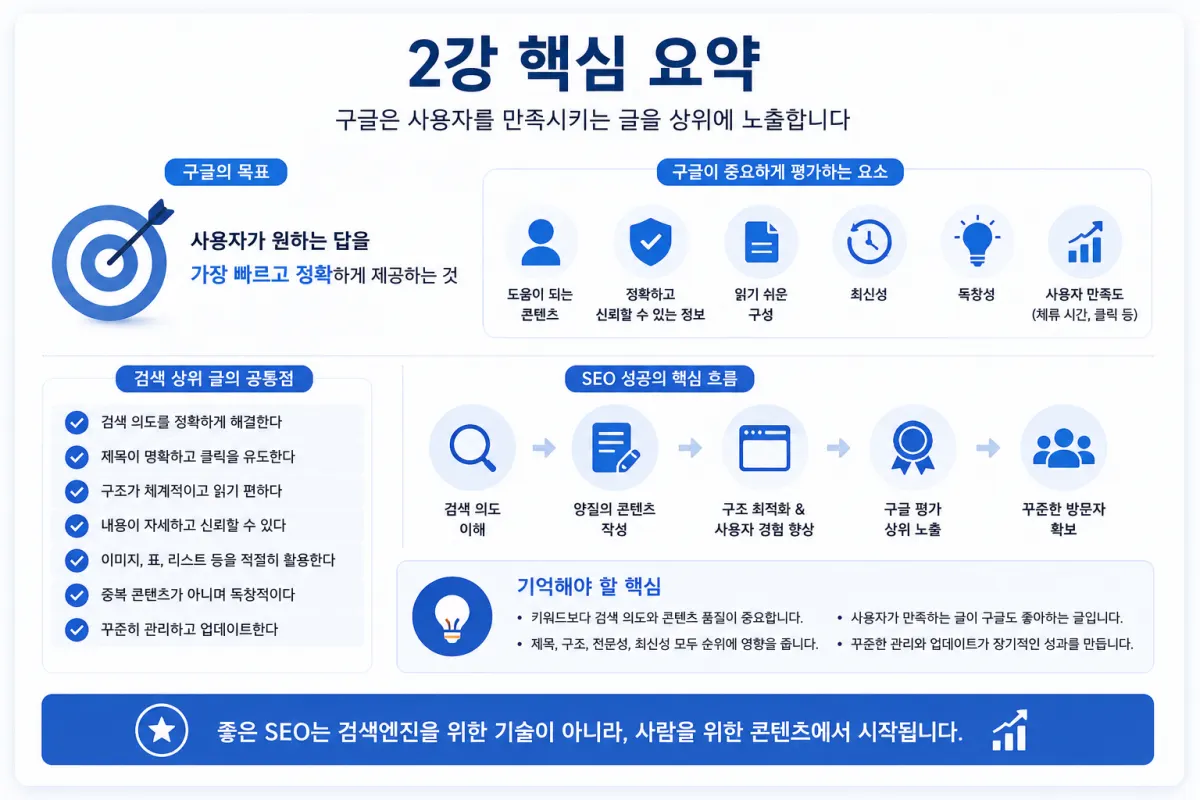
Key Takeaways From This Lesson
This lesson explored how Google evaluates content for rankings.
The key points to remember are:
Google's goal is user satisfaction.
Articles that solve search intent get higher ratings.
Content quality matters more than keyword stuffing.
Title and structure significantly impact visibility.
Expertise and trustworthiness give content an edge.
Regular updates boost SEO performance.
Quality is far more important than whether the content was AI or human-written.
Understanding these principles will change how you approach every piece of writing.
In our next lesson, we'll dive into "Why Keyword Selection Accounts for 80% of SEO"—the most critical first step in driving search traffic.
FAQ
Does using AI to write content hurt SEO rankings?
No, Google cares about quality, accuracy, and whether the content meets search intent—not whether it was written by a human or AI.
Why does my article rank low even with good keywords?
Google prioritizes user satisfaction. If your content doesn't solve the searcher's problem or is poorly structured, it won't rank well regardless of keyword use.
Korean Source
This article is an English localization of a Korean-language report from BlogScore. Original: [SEO 2강] 구글은 어떤 글을 상위에 노출할까? SEO 핵심 원리