
Predicting Solar Eclipses: Cycles and Next Occurrences


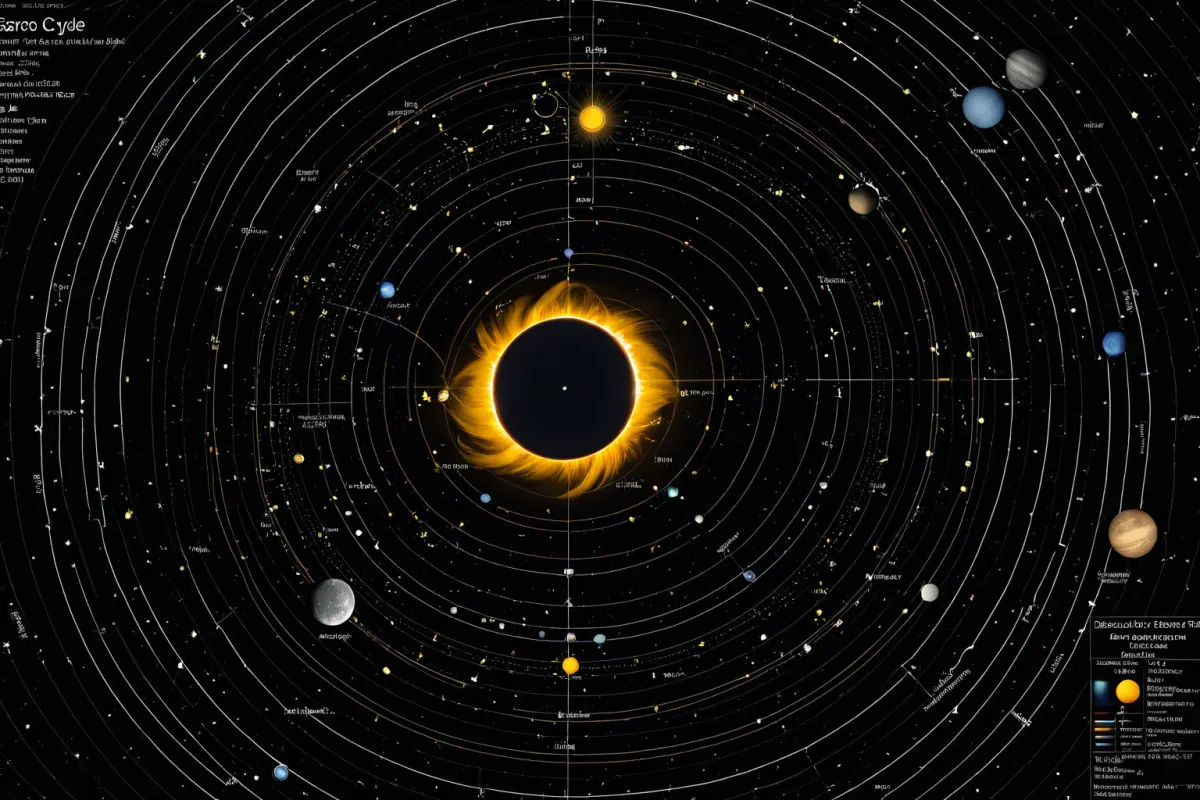
Solar Eclipse Cycles and the Saros Cycle
Total solar eclipses occur approximately every 7 years, but can be precisely predicted using the Saros cycle. The most recent total solar eclipse was observed in North America on April 8, 2024, with the next ones expected in July and August 2026 over Europe and Vietnam. A total solar eclipse is anticipated to be visible from the Korean Peninsula in 2035.
Scientific Basis of Solar Eclipse Cycles
Total solar eclipses occur due to the size ratio between the Sun and Moon. Although the Sun is about 400 times larger than the Moon, they appear similar in size from Earth, creating conditions for eclipses. The Saros cycle repeats every approximately 18 years, 11 days, allowing precise prediction of solar eclipses.
Recent and Future Total Solar Eclipse Dates
The total solar eclipse observed on April 8, 2024, in North America was accurately predicted based on the Saros cycle. Following this, a total lunar eclipse will be visible from Bogyuksan Observatory in Yeongcheon City on September 8, 2025, and another total lunar eclipse is scheduled for March 2, 2026, during the Lantern Festival (Jeongwol Daeboreum). Total solar eclipses are planned for North America in July 2026 and Europe and Vietnam in August 2026.
A total solar eclipse is expected to be visible from the Korean Peninsula in 2035. This prediction is based on the Saros cycle calculation using historical eclipse data.
Difference Between Total Solar and Lunar Eclipses
Total lunar eclipses occur when the Moon passes completely into Earth's shadow. A total lunar eclipse is scheduled for March 2, 2026, during the Lantern Festival (Jeongwol Daeboreum), which happens approximately every 36 years. Total solar and lunar eclipses have different cycles and observable locations.
Total solar eclipses occur when the Moon blocks the Sun's view, while total lunar eclipses happen when Earth blocks the Sun from reaching the Moon. This difference results in varying observation times and locations for each phenomenon.
Understanding Cyclical Phenomena
Solar eclipse cycles appear approximately every 7 years but require consideration of the Saros cycle for accurate prediction. The Saros cycle spans about 18 years, 11 days, and 8 hours, during which eclipses repeat. Thus, solar eclipse timing can be more precisely predicted using this cycle.
The April 8, 2024, total solar eclipse observed in North America was predicted as part of the Saros cycle, based on historical eclipse data and current astronomical calculations.
Visibility of Total Solar Eclipses from the Korean Peninsula
A total solar eclipse is expected to be visible from the Korean Peninsula in 2035. This prediction comes from Saros cycle calculations based on past eclipse observations. However, specific timing details for viewing a total solar eclipse over the Korean Peninsula were not clearly specified as of 2017.
The Korean Peninsula is an area where total solar eclipses are difficult to observe due to Earth's rotation and the inclination of the Moon's orbit. Therefore, witnessing a total solar eclipse from this region is relatively rare.
Predicting Total Solar Eclipses
The Saros cycle plays a key role in predicting total solar eclipses, repeating approximately every 18 years and 11 days. This allows for precise calculation of when total solar eclipses will occur. Additionally, the size ratio between the Sun and Moon provides the conditions necessary for eclipse phenomena.
The total solar eclipses scheduled for July 2026 in North America and August 2026 in Europe and Vietnam have been accurately predicted using the Saros cycle, based on astronomical data and historical observations.
Cycle of Total Lunar Eclipses
Total lunar eclipses can occur every 36 years around the Lantern Festival (Jeongwol Daeboreum). A total lunar eclipse is scheduled for March 2, 2026, from 8 PM to 9 PM. This prediction is based on historical observation data.
Total lunar eclipses happen when Earth blocks sunlight from reaching the Moon, differing in mechanism from solar eclipses. Therefore, their cycles differ from those of total solar eclipses. The occurrence every 36 years around the Lantern Festival illustrates this cyclical pattern.
Important Considerations for Observing Solar Eclipses
When observing a total solar eclipse, always use safe methods to avoid eye damage. Direct viewing is harmful; instead, use specialized eclipse glasses or indirect observation devices.
It's advisable to check the location and time in advance and refer to information provided by observatories or official organizations. In particular, residents of regions where eclipses are expected in 2026 (North America, Europe, Vietnam) should prepare ahead of time.
Addition Information on Solar Eclipses
Total solar eclipses provide an excellent opportunity to observe the Sun's outer atmosphere, known as the corona. This phenomenon is visible only during a total solar eclipse and serves as important data for astronomical research.
The April 8, 2024, total solar eclipse observed in North America was used by many scientists to study the corona. This demonstrates how eclipses contribute to astronomical research.
Information to Verify
Total solar eclipse cycles occur approximately every 7 years and can be predicted using the Saros cycle. The April 8, 2024, total solar eclipse in North America was accurately predicted based on historical data.
The upcoming total solar eclipses scheduled for July 2026 in North America and August 2026 in Europe and Vietnam have been calculated using the Saros cycle. A total solar eclipse is anticipated over the Korean Peninsula in 2035.
Frequently Asked Questions
How are solar eclipses predicted? Solar eclipses can be predicted using the Saros cycle, which repeats approximately every 18 years and 11 days. This allows for calculation of eclipse occurrence timing based on historical data.
When will a total solar eclipse be visible from the Korean Peninsula? A total solar eclipse is expected to be visible over the Korean Peninsula in 2035. However, specific details as of 2017 were not clearly provided.
What is the difference between a total solar and lunar eclipse? Total solar eclipses occur when the Moon blocks the Sun's view, while total lunar eclipses happen when Earth blocks sunlight from reaching the Moon. These phenomena have different cycles and observable locations.
Frequently Asked Questions
Total solar eclipses occur approximately every 7 years and can be accurately predicted using the Saros cycle. The most recent was observed in North America on April 8, 2024; the next ones are scheduled for July and August 2026 over Europe and Vietnam. A total solar eclipse is expected to be visible from the Korean Peninsula in 2035.
When observing a total solar eclipse, it's important to use safe methods. Accurate prediction using the Saros cycle helps determine exact timing. Residents of regions where eclipses are scheduled for 2026 (North America, Europe, Vietnam) should prepare in advance.
You can view similar articles on this topic all at once.
View Related ArticlesFAQ
How are solar eclipses predicted?
Solar eclipses can be predicted using the Saros cycle, which repeats approximately every 18 years and 11 days. This allows for calculation of eclipse occurrence timing based on historical data.
When will a total solar eclipse be visible from the Korean Peninsula?
A total solar eclipse is expected to be visible over the Korean Peninsula in 2035. However, specific details as of 2017 were not clearly provided.
What is the difference between a total solar and lunar eclipse?
Total solar eclipses occur when the Moon blocks the Sun's view, while total lunar eclipses happen when Earth blocks sunlight from reaching the Moon. These phenomena have different cycles and observable locations.
Korean Source
This article is an English localization of a Korean-language report from BlogScore. Original: 개기일식 주기와 다음 발생 시점 예측 방법