
How to Write SEO-Friendly Content for Better Search Rankings

Why Content Matters in SEO
Many people think SEO is just about stuffing keywords into your content.
However, the most important factor determining search rankings is content quality.
Search engines analyze the entire body of text, not just the title.
Does it answer the user's question?
Is the content thorough enough?
Is it easy to read?
Is it trustworthy information?
All these factors are considered together.
In short, great content is essential for good SEO.
Lead with the Answer in Your First Paragraph
Users want the answer first, not a long explanation.
For example:
If your article is about "AdSense approval time"
A poor example would be:
AdSense is Google's advertising service...
A better example would be:
AdSense approval typically takes 1 to 2 weeks.
Starting with the key information in your first paragraph works well.
Search engines also prefer this structure.
Keep Paragraphs Short
With more mobile users, long paragraphs are hard to read.
Try to keep them:
2-4 lines long
On a single topic
Clearly separated by meaning
Shorter paragraphs improve readability and increase the chance users will read all the way to the end.
Use H2 and H3 Headings to Organize Content
Even great content becomes hard to read if it's just a long block of text without headings.
For example:
H2
Why SEO Matters
H3
The Role of Search Engines
H3
User Experience
Breaking content into sections with headings makes it easier for both search engines and users to find what they need.
Focus on One Topic Per Article
A common mistake beginners make is trying to cover multiple topics in one article.
For example, including:
SEO
AdSense
WordPress
YouTube
All in a single post makes it hard for search engines to determine the article's main focus.
The most effective approach is to deeply cover one core topic per article.
Naturally Incorporate Keywords
In the past, repeating keywords was thought to help SEO.
But today, it's the opposite.
The following example isn't good:
SEO is important. Study SEO for SEO purposes.
Search engines prefer naturally written content.
Naturally include your main keyword in:
The title
The first paragraph
H2 headings
The body text
That's sufficient.
Provide Useful, Practical Information
Search engines prefer content that offers real value over simple explanations.
For example, instead of just saying "SEO is important," include:
Real examples
Illustrations
Comparisons
Tables
Checklists
This makes your content much more valuable.
Use Images Appropriately
Long blocks of text can make readers tired quickly.
Adding images at appropriate points, such as:
Main images
Explanatory images
Tables
Infographics
Makes content easier to understand.
Be sure to include ALT attributes for all images.
Write for Easy Reading
SEO isn't about writing difficult content.
Your content should be easy for anyone to understand.
Good writing includes:
Simple vocabulary
Shorter sentences
One idea per sentence
The easier your content is to understand, the higher user satisfaction will be.
Create Trustworthy Information
Search engines prioritize accuracy and trustworthiness.
Try to include:
Up-to-date information
Personal experience
Official sources
Objective explanations
Especially for content that may change over time, regular updates help with SEO.
End Your Article Thoughtfully
It's helpful to summarize the key points at the end of your article.
For example:
The main takeaways from this post
Key things to remember
Next steps
This helps users review the content and gives search engines a better understanding of your article structure.
Common Mistakes Beginners Make
The following mistakes can hurt your SEO performance:
First paragraph is too long
No headings, just long paragraphs
Overusing keywords
Including multiple topics in one article
Just increasing word count without adding value
Lacking practical information
Fixing these issues can significantly improve your content quality.
Characteristics of High-Quality SEO Content
If you look at articles ranking well, they share common features:
They provide the answer in the first paragraph
They use well-structured H2 and H3 headings
They have short, easy-to-read paragraphs
They include examples and real cases
They appropriately use images and tables
They reflect up-to-date information
They're structured for complete readability
All these elements combine to create effective SEO content.
Key Takeaways from This Lesson
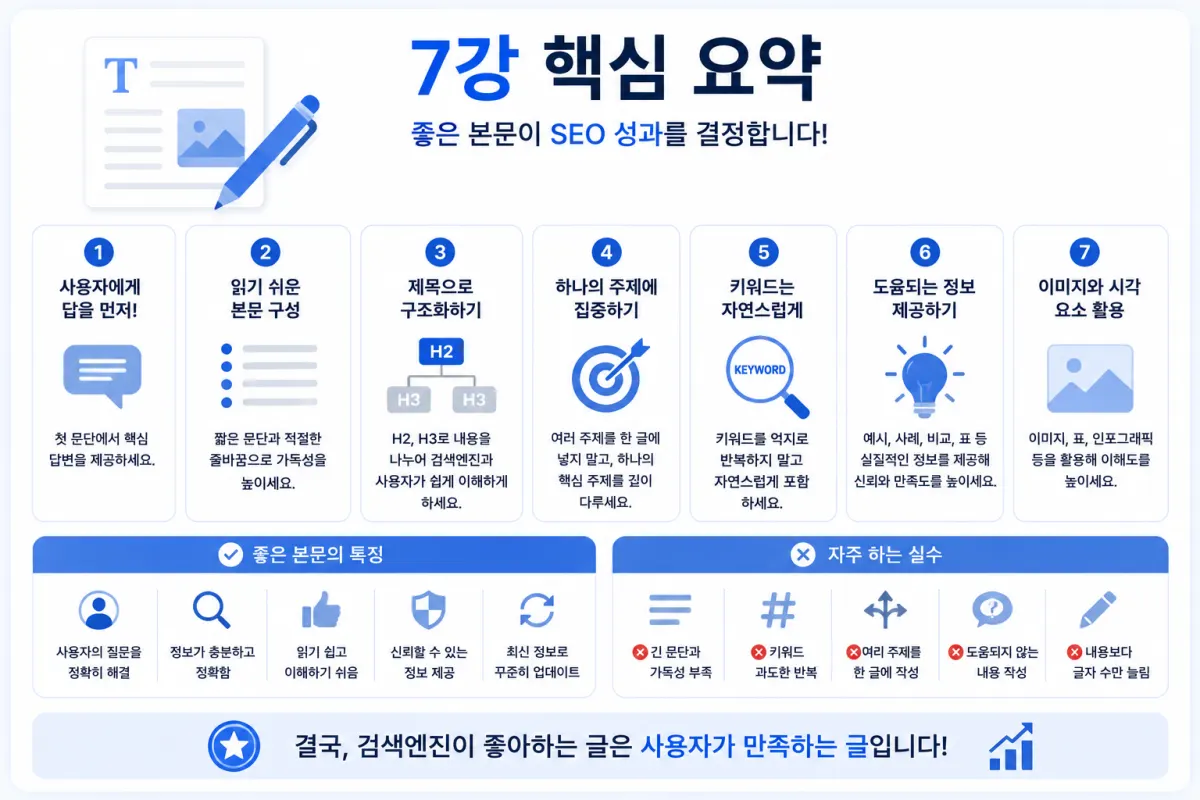
This lesson covered how to write content that's friendly for search engines.
The key points to remember are:
Content quality determines SEO success
Start with the main answer in your first paragraph
Use short paragraphs and clear heading structure
Focus on one topic per article
Naturally incorporate keywords
Provide practical, helpful information
Use images and tables to improve readability
The best SEO content is easy for people to read and enjoy.
Ultimately, search engines favor content that's easier for people to read.
In our next lesson, we'll explore "Why You Should Always Include Internal Links" and how to use them effectively in your SEO strategy.
FAQ
Why is content quality more important than keyword stuffing for SEO?
Search engines analyze the entire body of text to determine if it answers user questions, provides thorough information, and is trustworthy. Natural, high-quality content that addresses user needs ranks better than content filled with repeated keywords.
How long should paragraphs be in SEO-friendly content?
Shorter paragraphs are recommended—ideally 2-4 lines—to improve readability on mobile devices and increase the likelihood users will read through your entire article.
Korean Source
This article is an English localization of a Korean-language report from BlogScore. Original: [SEO 7강] 본문을 어떻게 작성해야 SEO에 유리할까?