
How to Draw Penrose Stairs: A Simple Hand-Drawn Guide
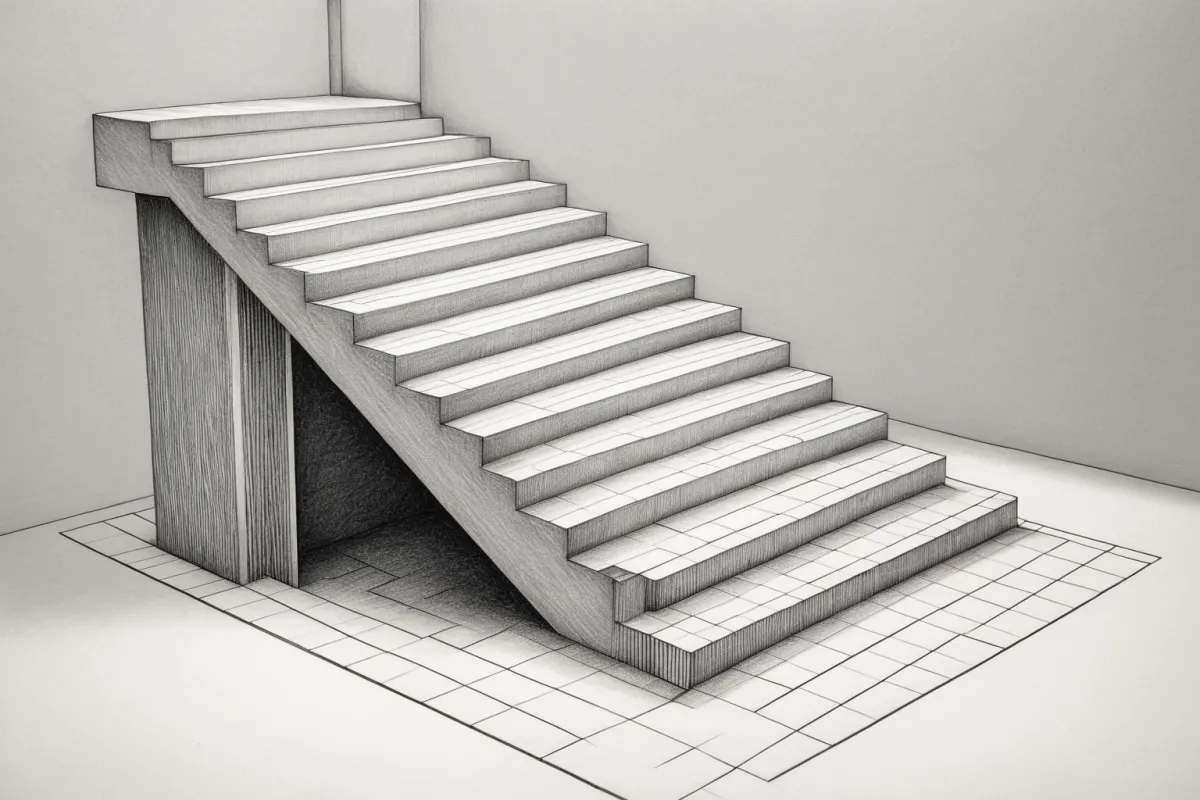
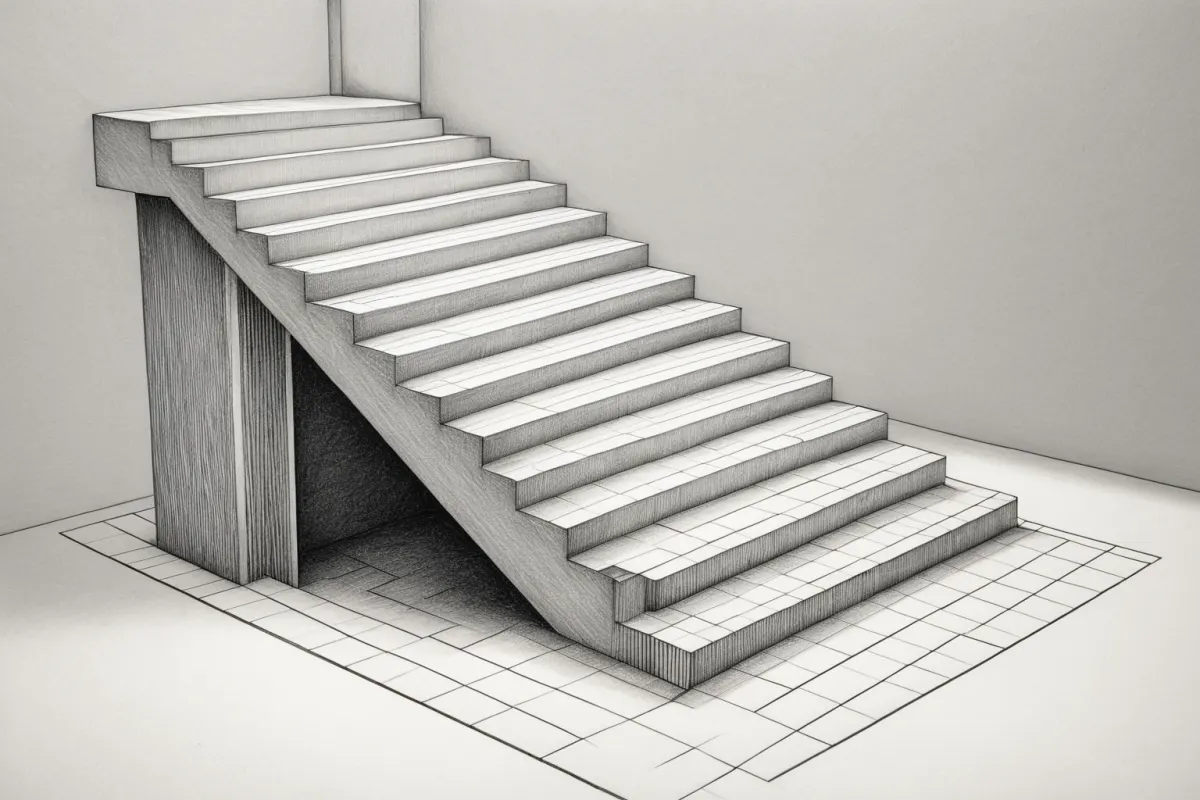
Drawing the Penrose stairs is an exercise in creating an impossible structure on paper that appears to be a continuous upward staircase. The key lies in deceiving the viewer through perspective and line connections. A hand-drawn approach makes this easier by connecting four stair segments into one seamless loop-like structure.
While it may seem like a simple drawing trick, attempting to draw it reveals why people get confused. From afar, the stairs clearly appear to go upward, but up close, they connect in impossible directions that couldn't exist in reality.
What Are Penrose Stairs?
The Penrose stairs are a well-known impossible figure, popularized by British mathematician Roger Penrose and his family's ideas. The staircase appears to continue upward in one direction, but in actual space, it cannot form a closed loop.
You'll often find searches for 'Penrose stairs' or the 'Penrose stairs principle,' both referring to the same visual illusion. It's important to remember that this is not a 3D structure you can build—it's a 2D optical illusion on paper.
You can find more articles on similar topics in one place.
View Related ArticlesStep-by-Step Guide to Drawing Penrose Stairs
You don't need to start complexly when drawing the Penrose stairs by hand. Begin by dividing four stair segments into short straight sections, arranging them so each segment connects smoothly to the next.
Start with a section that appears to go downward from below, then connect its end to an adjacent side staircase. Continue this pattern—each new section should seem to flow naturally into the next—to create a structure that appears to endlessly climb or descend on paper.
Think of it like this: starting from the lower left, the stairs move to the lower right, then upward, and finally loop back near the starting point. In reality, only the meeting points of lines are adjusted on the flat surface—so it looks perfect when viewed head-on.
Mastering Perspective in Hand-Drawn Stairs
When drawing Penrose stairs, getting the viewing angle right is more important than neatly drawing each line. Some sections should look like front-facing stairs, while others should resemble side views.
Maintaining consistent stair width and height enhances the illusion. If the proportions vary between segments, it will quickly look off—beginners are advised to lightly sketch with pencil first.
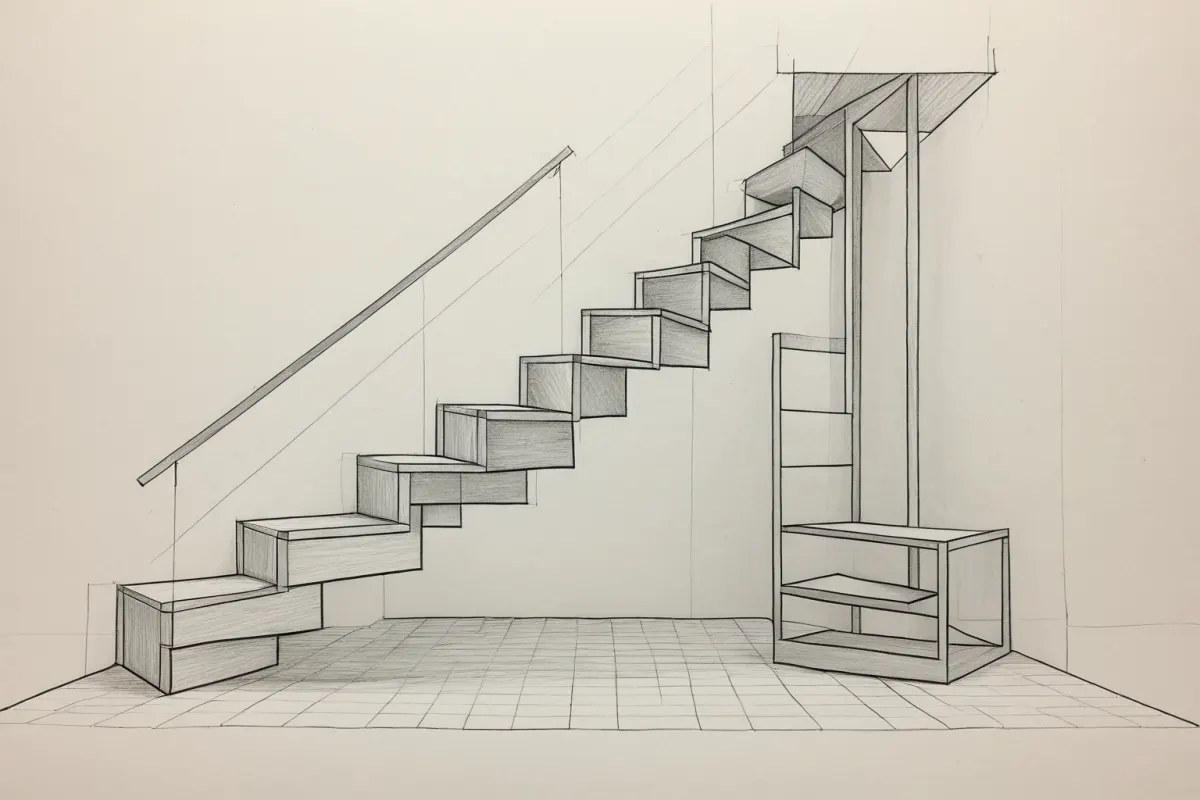
Why Penrose Stairs Confuse People
People get confused when viewing this structure because the brain interprets it as a 3D space. Individual lines look natural, but when seen as a whole, conflicting directions mix together.
For example, stairs may clearly seem to go up, yet at the final connection point, they appear lower than the starting position. This contradiction is what makes impossible figures so intriguing—while it doesn't work in reality, the illusion tricks you into believing it for a moment.
Practice Examples for Hand-Drawn Stairs
When practicing, start with simple shapes rather than complex decorations. Imagine four square stair blocks, each ending where the next begins.
The first example involves drawing a rectangular staircase in the center of the paper and connecting its right end to an upward staircase. The second example reverses the left and bottom positions for a different orientation—changing direction can help you grasp the Penrose stairs concept faster.
After sketching with pencil, check which sections don't connect realistically and refine them with an eraser. Focus less on drawing perfectly from the start and more on finding where the illusion works best.
Real-World Applications of Penrose Stairs
The Penrose stairs are commonly used in art, design, and educational materials to illustrate impossible figures. Their strong visual impact makes them popular for posters and video thumbnails.
However, since this structure can't be built as a real 3D space, exhibitions or displays set it up to look complete from a specific angle. This is why Penrose stairs images continue to gain attention online.
Understanding this principle also helps you recognize other impossible figures. While the idea itself is simple, effective application requires attention to lighting, shadows, and line thickness for a convincing illusion.
Pro Tips for Better Visibility
If you're new to drawing Penrose stairs, avoid making lines too thick—overly bold lines can reveal where connections happen, weakening the illusion.
Keep backgrounds simple; complex surroundings will draw attention away from the staircase flow. You can practice effectively with just pencil and white paper, and as you get comfortable, expand into colored pencils or digital drawing.
Start small to master the structure before scaling up—especially at corners where connections matter most. Getting these right makes the entire illusion much more convincing.
Frequently Asked Questions
Q1: Can Penrose stairs be built in real life?
No, they cannot exist in physical space. However, you can create them to look like this from a specific angle or draw them on paper.
Q2: Are Penrose stairs and Penrose triangles the same thing?
No—they're part of the same family of impossible figures but have different shapes. Stairs give a layered appearance, while triangles involve contradictory connections between three sides.
Q3: Can beginners draw Penrose stairs easily?
Yes, it's possible. Start by placing four simple stair blocks and check if the perspective aligns correctly through repeated practice.
Drawing Penrose stairs is ultimately about tricking the eye with perspective rather than reality. Once you grasp the basics, even complex impossible figures become manageable to draw by hand. For more accurate information on expression methods or terminology, check recent exhibitions or educational materials as interpretations may vary.
Continue exploring similar topics.
View Category ArticlesFAQ
Can Penrose stairs be built in real life?
No, they cannot exist in physical space. However, you can create them to look like this from a specific angle or draw them on paper.
Are Penrose stairs and Penrose triangles the same thing?
No—they're part of the same family of impossible figures but have different shapes. Stairs give a layered appearance, while triangles involve contradictory connections between three sides.
Can beginners draw Penrose stairs easily?
Yes, it's possible. Start by placing four simple stair blocks and check if the perspective aligns correctly through repeated practice.
Korean Source
This article is an English localization of a Korean-language report from BlogScore. Original: 펜로즈의 계단 만들기, 손그림으로 이해하는 방법