
How to Choose Profitable Keywords for AdSense: Real-World Tips


How to Choose Profitable Keywords for AdSense: Real-World Tips
In the previous lesson, we learned about SEO writing structure.
Now it's time to learn how to choose keywords that generate revenue, not just visibility.
Many people assume "more searches mean more money," but AdSense works differently.
The same number of visitors can lead to vastly different earnings depending on which keyword brought them in.
This lesson will break down the criteria for finding profitable keywords.
High Search Volume Doesn't Mean High Revenue
Consider these examples:
A keyword
Monthly searches: 100,000
CPC: 50 won
B keyword
Monthly searches: 5,000
CPC: 1,000 won
You can't judge by search volume alone.
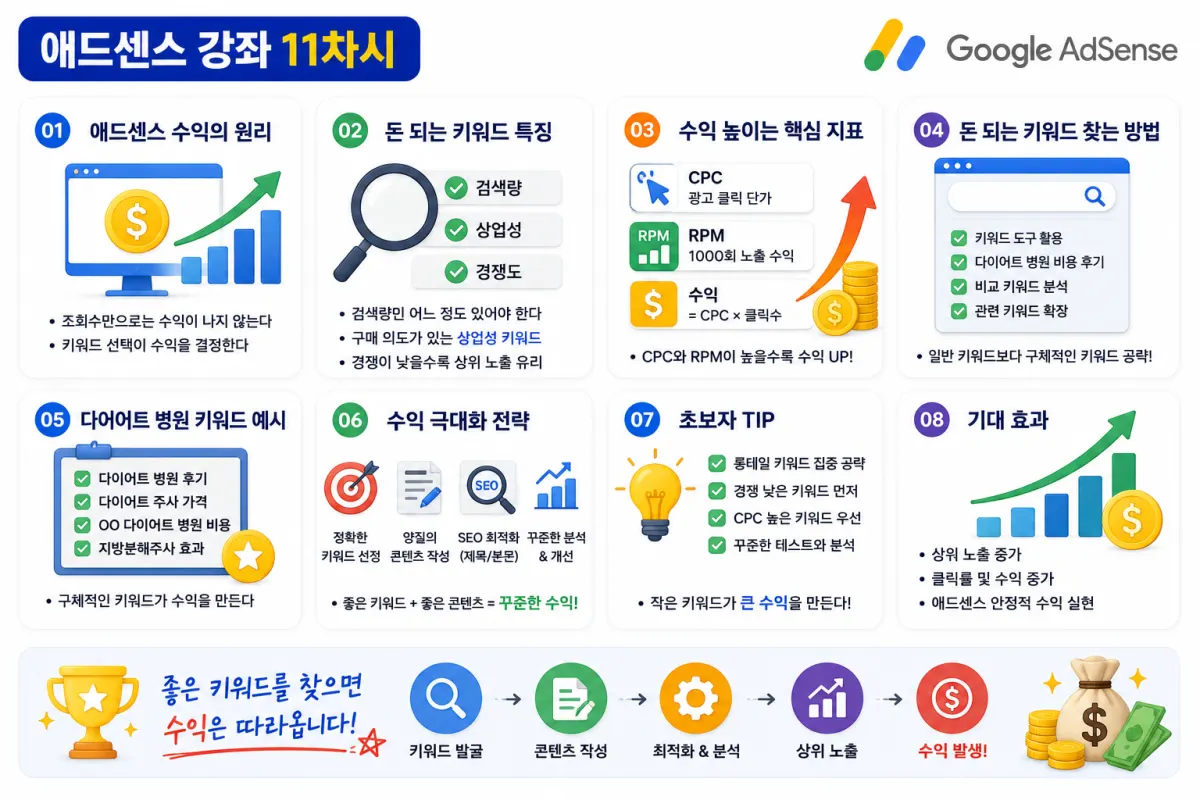
You need to consider ad cost per click (CPC), competition level, and search intent.
What Is CPC?
CPC stands for Cost Per Click.
In simple terms, it's the price an advertiser pays each time someone clicks their ad.
Keywords in industries with high CPC typically generate better AdSense earnings.
Industries with notably high CPC include:
Insurance
Finance
Loans
Investing
Law
Healthcare
IT
B2B software
What Is RPM?
RPM stands for Revenue Per Mille.
In simpler terms, it's the estimated earnings per 1,000 page views.
For example:
1,000 page views
↓
$5 revenue
Then RPM is $5.
RPM reflects multiple factors including CPC, click-through rate, and ad display methods.
RPM is a crucial metric for AdSense publishers.
Characteristics of Profitable Keywords
High-revenue keywords share common traits:
They indicate purchase intent.
They solve specific problems.
Users are likely to click ads.
Many advertisers compete in the space.
For example:
"Laptops"
is less effective than
"Best laptops for students"
because the latter has clearer search intent.
Competition Level Matters Too
High search volume and high CPC don't guarantee success.
If competition is too intense, ranking becomes difficult.
For example:
The keyword "insurance" faces stiff competition from large companies and major media outlets.
But a long-tail keyword like
"20s car insurance discount tips"
is more accessible for beginners.
Search Intent Is Key
The same keyword can have different search intents.
For example:
"iPhone" is too broad,
but specific variations like
"How to make iPhone battery last longer"
<"How to transfer iPhone data"
"How to take screenshots on iPhone"
clearly show user intent.
Clear search intent makes SEO more effective.
Profitable Keyword Examples
Industries with high CPC include:
Finance
Insurance
Credit cards
Stocks
Real estate
Automobiles
Healthcare
Hospitals
Law
Business startup
AI
Web hosting
Servers
Marketing
Software programs
Naturally, competition level must also be considered.
Newcomers should focus on specific topics rather than broad keywords.
Balance Search Volume and Competition
The ideal keyword meets these criteria:
Sufficient search volume
Moderate competition level
Clear search intent
High CPC industry
Considering all four factors increases your chances of finding a profitable keyword.
One Article, One Primary Keyword
Avoid cramming multiple keywords into one article.
For example:
AdSense
WordPress
SEO
YouTube
Blogs
Coupang Partners
Trying to cover all these topics dilutes your article's focus.
Focus on one primary keyword per article for better SEO results.
Common Mistakes Beginners Make
These errors frequently occur:
Selecting keywords based solely on search volume
Failing to check competition levels
Ignoring CPC entirely
Choosing overly broad keywords
Not considering search intent
Avoiding these mistakes improves both visibility and revenue.
Profitable Keyword Checklist
Before writing, verify:
Does it have search volume?
Is competition manageable?
Is it in a high-CPC industry?
Is search intent clear?
Is it a long-tail keyword?
Have you focused on one primary keyword?
This checklist simplifies the keyword selection process.
Profitable Content Doesn't Happen by Chance
Successful AdSense earners don't just write randomly.
They analyze keywords,
understand search intent,
check competition levels,
and select high-revenue keywords.
Consistently applying this process leads to growing site revenue over time.
Conclusion
To succeed with AdSense, focus on high-revenue keywords instead of just high-search-volume ones.
Analyzing CPC, RPM, competition, and search intent allows you to earn more with the same effort.
In our next lesson, we'll explore how to write effective SEO content using AI (ChatGPT), covering practical methods for creating content that satisfies both search engines and readers.
FAQ
What is CPC in AdSense?
CPC (Cost Per Click) is the amount an advertiser pays each time a user clicks their ad. Higher CPC industries like finance and insurance typically generate better AdSense earnings.
Why should I avoid broad keywords?
Broad keywords have high competition and unclear search intent, making it difficult to rank and earn revenue. Long-tail keywords with specific intent are more profitable for beginners.
Korean Source
This article is an English localization of a Korean-language report from BlogScore. Original: [11차시-실전편] 애드센스 수익이 나는 키워드 고르는 방법! 돈 되는 키워드 찾는 실전 노하우