
AI and Aging Populations: Economic Impacts in South Korea
Economic Impact of Aging Society and AI Development
An aging society and advancements in AI technology present both economic risks and opportunities. In China and South Korea, robotics and AI automation are being introduced to address labor shortages caused by population decline. The government is prioritizing the 'AI for All' principle, focusing on developing the silver care industry and activating the care economy. By 2030, health insurance spending is projected to reach 20 trillion won, with AI deemed essential for operating healthcare systems in a super-aging society.
Adopting AI Technology to Address Population Decline
In China and South Korea, robotics and AI automation are being implemented to tackle labor shortages due to population decline. China is actively adopting robotics, AI, and automation technologies to address its demographic challenges, while South Korea follows a similar path. In November 2025, President Yoon announced plans to solve the population crisis through cultural innovation industries alongside AI development. Around the same time, Choi Tae-won advocated at the Tokyo Forum for an 'AI-driven era of measuring social value' and promoted a 'new capitalism.'
Government Strategy: AI for All
In 2025, during APEC, the president presented 'AI for All' as a core principle. This reflects the government's commitment to leading efforts so that AI technology improves lives across all social strata and contributes to resolving aging society challenges. Both government and businesses are focusing on using AI to measure social value and secure new growth drivers, part of a broader strategy addressing economic shifts caused by low birth rates and aging.
Alleviating Medical Burden with AI Technology
Health insurance spending is projected to reach 20 trillion won by 2030, highlighting the difficulty of sustaining healthcare systems in a super-aging society. It is emphasized that maintaining such systems would be extremely difficult without AI. In August 2026, the Busan Institute proposed strategies for developing the silver care industry, aiming to transform welfare burdens into industrial opportunities.
Silver Industry Growth and AI-Bio Technology
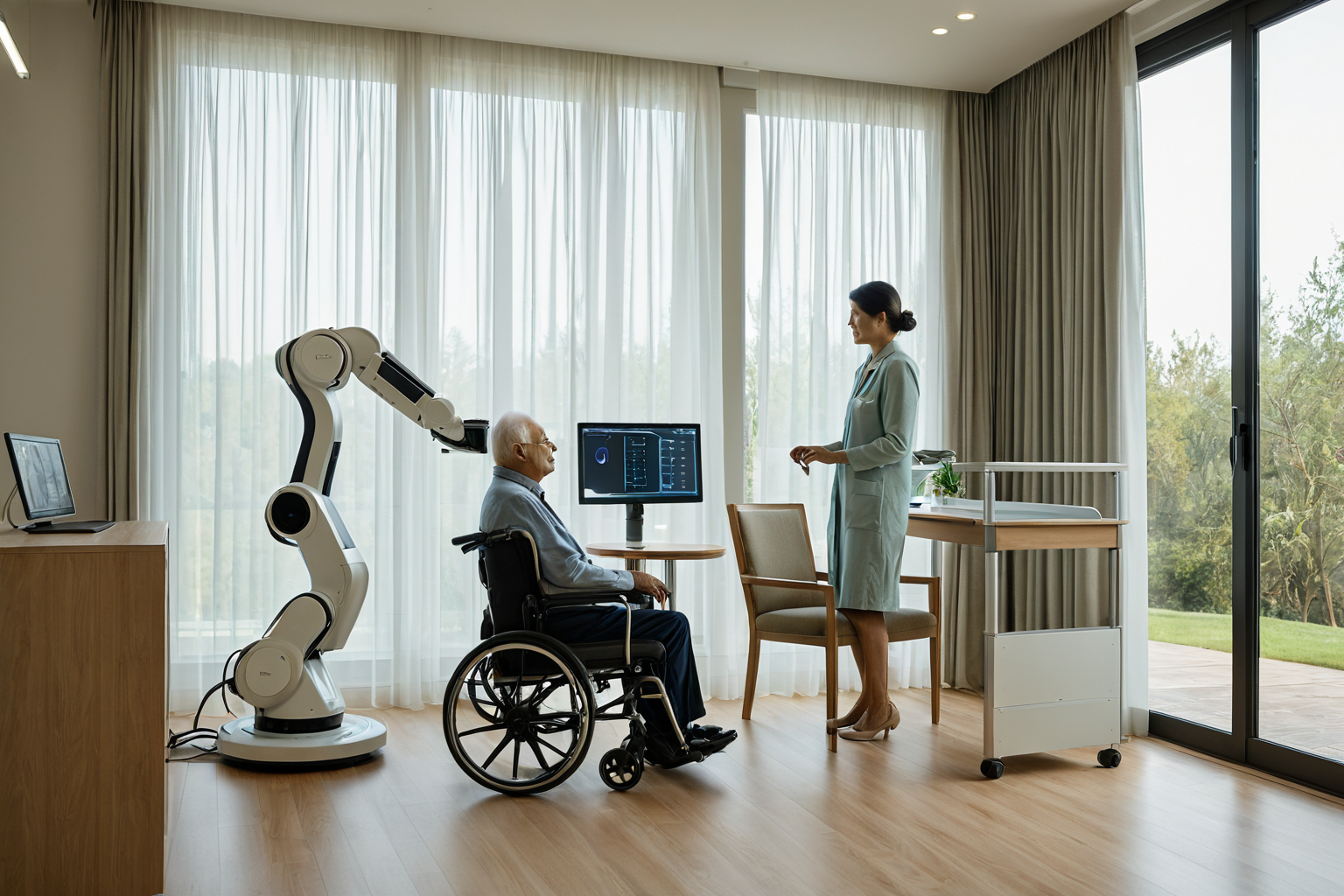
AI and bio-technology are emerging as key drivers of growth in the silver industry. At a Bank of Korea-Yonsei University symposium in February 2026, strategies were presented to leverage super-aging society as an industrial opportunity. Lee Chang-yong emphasized that the silver economy represents new business opportunities. Development of robotic nursing assistants is underway, aiming to reduce 'old-old care' burdens.
Economic Structure Shift and Male Youth Labor Participation
South Korea's economic structure—interest rates, growth, fiscal framework—is changing due to low birth rates and aging, necessitating urgent structural reform. Particularly, male youth labor participation rates fall below OECD averages and are declining under the combined impact of AI adoption and aging. In 2026, Semyung University introduced a course on AI-based fall prevention education programs.
AI Expansion and Economic Burden
The economic drag caused by savings rather than spending from AI-driven gains is also noteworthy. Goldman Sachs noted that the benefits of AI semiconductor booms in Korea, driven by aging populations, are being offset by the need for more equitable corporate profit distribution.
Future Outlook and Structural Reform
When analyzing the economic impact of an aging society and AI development, it should not be viewed merely as a burden. Converting economic burdens into opportunities through developing silver care industries and activating the care economy is essential. With government 'AI for All' strategies and growth in the silver industry driven by AI-bio technology, South Korea's economy could find new momentum.

Economic Impact of Low Birth Rates and Aging Society
Low birth rates and aging are causing changes in South Korea's interest rates, growth patterns, and fiscal structure, necessitating urgent structural reform. Male youth labor participation rates remain below OECD averages, declining under the combined effects of AI expansion and aging.
Strategy for Developing Silver Care Industry
In August 2026, the Busan Institute proposed transforming high-age society from a welfare burden into an industrial opportunity to develop the silver care industry. The National Assembly has also discussed care economy and industry development strategies from the perspective that 'care is an investment, not a cost.'
AI Technology and Healthcare Systems
By 2030, health insurance spending is projected to reach 20 trillion won, indicating that AI is essential for operating healthcare systems in a super-aging society. Development of robotic nursing assistants contributes to reducing 'old-old care' burdens, while the integration of AI and bio-technology drives growth in the silver industry.
Response Strategies for Economic Structural Changes
At the Bank of Korea-Yonsei University symposium, Lee Chang-yong presented strategies for leveraging super-aging society as an industrial opportunity. This requires converting economic burdens into opportunities and advancing AI adoption alongside aging population solutions.
Frequently Asked Questions
How is AI being utilized in aging societies?
AI is being applied across various sectors including robotic nursing assistants, fall prevention education programs, and healthcare system operations. It particularly contributes to developing the silver care industry and activating the care economy.
What strategies has the government set to address aging challenges?
The government has adopted 'AI for All' as a core principle, focusing on developing the silver care industry and activating the care economy. The strategy was officially presented at APEC in 2025 to tackle aging society issues.
What are the economic impacts of low birth rates and aging?
Low birth rates and aging are causing changes in interest rates, growth patterns, and fiscal structures. Male youth labor participation rates fall below OECD averages, indicating urgent need for structural reform.
Frequently Asked Questions
The combination of an aging society and AI development should not be viewed merely as a burden. Converting economic burdens into opportunities through silver care industry development and activating the care economy is essential. With government 'AI for All' strategies, growth in the silver industry driven by AI-bio technology could become a new source of momentum for South Korea's economy. The projected 20 trillion won health insurance spending by 2030 provides an indication of how urgent these changes are.
Find similar articles on this topic in one place.
View Related ArticlesFAQ
How is AI being utilized in aging societies?
AI is applied across various sectors including robotic nursing assistants, fall prevention education programs, and healthcare system operations. It particularly contributes to developing the silver care industry and activating the care economy.
What strategies has the government set to address aging challenges?
The government has adopted 'AI for All' as a core principle, focusing on developing the silver care industry and activating the care economy. The strategy was officially presented at APEC in 2025 to tackle aging society issues.
What are the economic impacts of low birth rates and aging?
Low birth rates and aging are causing changes in interest rates, growth patterns, and fiscal structures. Male youth labor participation rates fall below OECD averages, indicating urgent need for structural reform.
Korean Source
This article is an English localization of a Korean-language report from BlogScore. Original: AI 기술 발전과 고령화 사회, 경제적 영향 분석